RRB Group D Syllabus 2026: If you are an Indian student dreaming of a secure career in the Indian Railways, the RRB Group D (Level 1) recruitment is likely your biggest opportunity this year. With over 22,195 vacancies announced in the 2026 notification (CEN 09/2025), the competition is fierce, but the path is clear if you know exactly what to study.
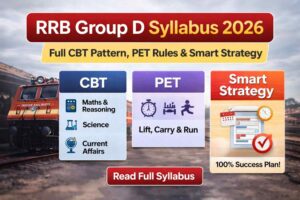
I’ve spent considerable time analyzing railway recruitment trends, and the biggest mistake candidates make is “over-studying” the wrong topics. This guide is designed to help you focus your energy where it actually counts—the high-weightage sections of the Computer-Based Test (CBT).
1. The 2026 Selection Workflow: How it Works
Before diving into the books, you need to understand the journey. Unlike previous years where there was talk of two-stage CBTs, the 2026 pattern follows a single CBT followed by physical and medical tests.
-
CBT (Computer Based Test): The main hurdle. Your merit is decided here.
-
PET (Physical Efficiency Test): Qualifying in nature (pass/fail).
-
Document Verification (DV): Checking your 10th/ITI certificates.
-
Medical Examination: Ensuring you meet the vision and fitness standards for Level 1 posts.
Read This Also: Bihar Board 12th Result 2026 OUT 85.19% Pass, Girls Lead – Check Now!
2. Detailed CBT Exam Pattern (The 100-Mark Battle)
The exam lasts 90 minutes (120 minutes for PwBD candidates). You have 100 questions to solve, and accuracy is your best friend because of the 1/3rd negative marking.
Subject-Wise Marks Distribution
| Subject | No. of Questions | Max Marks |
| General Intelligence & Reasoning | 30 | 30 |
| Mathematics | 25 | 25 |
| General Science | 25 | 25 |
| General Awareness & Current Affairs | 20 | 20 |
| Total | 100 | 100 |
3. RRB Group D Syllabus 2026: Subject-Wise Syllabus Breakdown
Mathematics (25 Questions)
Railway math isn’t about complex calculus; it’s about speed and logic. From experience, focusing on Arithmetic is the fastest way to score.
-
Must-Do Topics: Number System, BODMAS, Decimals, Fractions, LCM & HCF, Ratio and Proportion, Percentages, Mensuration (2D/3D), Time and Work, Time and Distance, Simple and Compound Interest, Profit and Loss.
-
The Secret: Practice 20-30 calculations daily. Speed in BODMAS can save you 5 minutes in the actual exam.
General Intelligence & Reasoning (30 Questions)
This is the highest-weightage section. It’s designed to test how you think under pressure.
-
Key Topics: Analogies, Alphabetical and Number Series, Coding and Decoding, Mathematical operations, Relationships (Blood Relations), Syllogism, Venn Diagram, Data Interpretation, Conclusions and Decision making.
-
Tip: Don’t get stuck on puzzles. If a seating arrangement takes more than 2 minutes, skip it and come back later.
General Science (25 Questions)
Many students waste time reading random science facts. Stick to the NCERT Class 9 and 10 standard.
-
Physics: Units, Motion, Work, Energy, Power, Light (Reflection/Refraction), and Electricity.
-
Chemistry: Periodic Table, Chemical Reactions, Acids, Bases, and Salts.
-
Life Sciences (Biology): Human Anatomy, Plant Kingdom, and Nutrition.
General Awareness & Current Affairs (20 Questions)
This covers Science & Technology, Sports, Culture, Personalities, Economics, and Politics. Focus on events from late 2025 to mid-2026.
Read This Also: Today IPL Match: PBKS vs GT | Prediction, Pitch Report, Playing XI
4. The PET: Don’t Forget the Physicals!
Clearing the written exam is only half the battle. If you fail the PET, your CBT score won’t matter.
Physical Requirements Checklist:
-
Male Candidates:
Lift and carry 35 kg for 100 meters in 2 minutes (without putting the weight down).
Run 1000 meters (1 km) in 4 minutes 15 seconds.
-
Female Candidates:
Lift and carry 20 kg for 100 meters in 2 minutes.
Run 1000 meters in 5 minutes 40 seconds.
5. Common Preparation Mistakes & Fixes
-
Mistake: Ignoring General Science thinking it’s “just GK.”
-
Fix: Science carries 25 solid marks. Read 10th-standard NCERT books thoroughly.
-
-
Mistake: Guesswork in the exam.
-
Fix: With 1/3rd negative marking, 3 wrong answers kill 1 right answer. If you are not 80% sure, leave it.
-
- Mistake: Ignoring the PET until the last minute.
-
-
Fix: Start light jogging and weight carrying practice at least 2 months before the expected date of the exam.
-
Summary:
Your Strategy for Success Your strategy for success in the Railway Group D 2026 written test should be to concentrate on Reasoning and Maths, which should cover 60% of your efforts, yielding 55 marks. The other 40% should be for Science and Current Affairs. Consistency is more important than intensity. It is better to study for 4 hours a day for 4 months than to study for 12 hours a day for 2 weeks.
Q&A (Real Doubts of Real Students)
1. What is RRB Group D Syllabus 2026?
RRB Group D Syllabus 2026 consists of four subjects: Mathematics, Reasoning, General Science, and Current Affairs. The test is an online test with 100 questions and negative marking.
2. What is the exam pattern for RRB Group D Syllabus 2026?
The RRB Group D Syllabus 2026 exam pattern is as follows: 100 questions for 100 marks, 90 minutes time duration, 1/3rd negative marking for wrong answers.
3. Is there a second stage for RRB Group D Syllabus 2026?
No, in RRB Group D Syllabus 2026, there is only one stage of CBT followed by PET, document verification, and the medical test. The result from the CBT will determine your selection.
4. What are the important topics in RRB Group D Syllabus 2026?
Important topics in RRB Group D Syllabus 2026 include Number System, Percentages, Reasoning Puzzles, basic Physics, Chemistry, Biology, and Current Affairs from the last few months.
5. How do I prepare for RRB Group D Syllabus 2026?
To prepare for RRB Group D Syllabus 2026, you must focus on your math and reasoning every day, study your science from the NCERT books, and practice mock tests regularly.